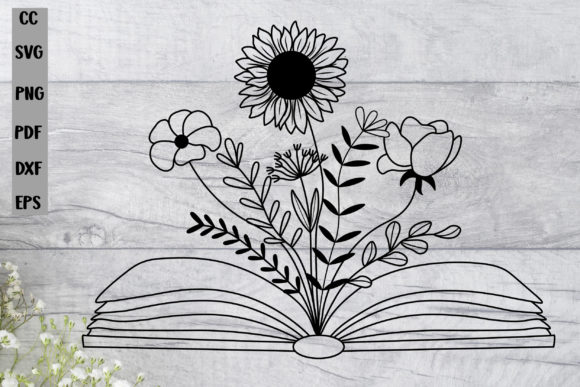
Wildflower Book SVG: Graphics & Print Templates for Handmade Brands
As a graphic designer who’s built brand identities for over a dozen small-batch makers—from botanical apothecaries to seasonal stationery studios—I recently evaluated the Wildflower Book SVG while developing a visual concept for a client launching a limited-edition wildflower-themed journal line. My goal wasn’t just to see if it “looks nice.” I needed to know: Does it hold up under real commercial pressure? Does it support storytelling, not distract from it? And most critically—does it scale across touchpoints without compromising polish or professionalism?
A First Impression That Feels Intentional, Not Generic
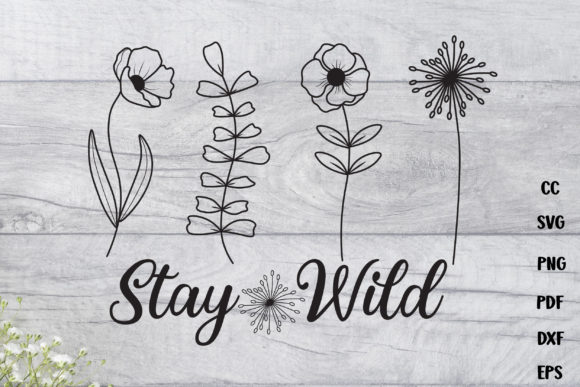
The Wildflower Book SVG lands with quiet confidence—not flashy, but rich in texture and organic rhythm. It’s not a single flower silhouette; it’s a layered, hand-guided composition suggesting open pages, delicate stems, and soft-petaled blooms arranged like something pressed between vellum. The linework balances precision and imperfection—clean enough for vector editing, gentle enough to feel handmade. This isn’t clipart. It reads as an illustration first, a design asset second.
That nuance matters. For a client whose brand voice centers on mindful creation and slow beauty, this mood aligns instantly. It avoids the overly sweet or cartoonish tone that can undermine credibility in premium handmade markets—and sidesteps the sterile minimalism that feels emotionally distant for nature-based storytelling.
Where Wildflower Book SVG Earns Its Place in Real Projects
In practice, the Wildflower Book SVG shines brightest where warmth and narrative cohesion are non-negotiable:
- Product mockups: Placed subtly on journal spines, belly bands, or digital product previews—it adds tactile authenticity without overwhelming the item itself.
- Packaging design: Works beautifully as a foil-stamped accent on kraft boxes or debossed into recycled paper tags. Its organic flow complements uncoated stocks and earthy color palettes.
- Social media graphics: Scales elegantly for Instagram carousels and Pinterest pins—especially when paired with serif or soft-serif typography (think Playfair Display or Cormorant Garamond) to reinforce literary elegance.
- Printable design & editorial layouts: As a decorative divider in digital workbooks or as a watermark-style background in blog headers, it adds visual interest without sacrificing readability.
- Cricut projects & sublimation design: With its clean SVG, DXF, and EPS files, it cuts precisely on vinyl and transfers crisply onto mugs, tote bags, and tea towels—ideal for Etsy sellers building cohesive product families.
It also functions well as a supporting element in brand identity systems—not as a logo (it lacks the singular focus needed), but as a consistent visual motif across business cards, thank-you notes, and email headers. That kind of continuity builds recognition faster than many realize.
Where to Proceed with Design Discipline
Like any strong creative design, the Wildflower Book SVG has boundaries. It shouldn’t be forced into contexts demanding razor-sharp clarity or extreme simplicity:
- Avoid using it at very small sizes (under 1.5 cm wide) on packaging labels—fine details blur, and stems lose definition.
- Don’t layer it over busy photographic backgrounds or complex patterns; its strength is subtlety, not contrast dominance.
- Resist pairing it with ultra-minimalist sans serifs (like Helvetica Neue Light) unless intentionally juxtaposing organic and industrial tones—it reads better with humanist or transitional typefaces.
- Steer clear in corporate or B2B branding where authority and neutrality outweigh emotional resonance.
Practical Designer Notes Before Client Use
Before committing the Wildflower Book SVG to a live project, I always run these checks:
- Test in black and white: Confirm legibility and weight balance—no hidden thin lines that vanish on print.
- Preview across backgrounds: Drop the PNG (with transparency) onto light, dark, and textured surfaces in your layout software. Does it retain presence without flattening?
- Scale it aggressively: Zoom out to 10% view and in to 400%. Does the composition hold? Do overlapping elements stay legible?
- Place on real mockups: Use it in a physical product mockup (e.g., printed journal cover) before finalizing—digital previews lie about texture and bleed.
- Verify file integrity: Open the SVG in Illustrator and check anchor point cleanliness. Inspect the PNG for anti-aliasing artifacts. Confirm the PDF retains vector fidelity when zoomed.
- Match fonts deliberately: Try it beside script fonts (for invitations), display fonts (for posters), and clean sans serifs (for web banners)—note how hierarchy shifts.
- Confirm licensing: Double-check the commercial license covers your client’s use case—especially for print-on-demand, digital resale, or merchandise. This is a Files Digital Download Print High Resolution 300 Dpi Wildflower Book SVG design Digital Print 6 Files package, so verify all six formats (SVG, PNG, DXF, PDF, EPS, and CC-compatible version) are cleared for your intended output.
Final Verdict: A Thoughtful Addition to Your Creative Marketplace Toolkit
The Wildflower Book SVG isn’t a shortcut—it’s a considered tool. It supports creative marketplace sellers building signature aesthetics, small business branding efforts rooted in authenticity, and editorial designers seeking organic texture without cliché. When used with intention—as part of a larger system, not as a standalone fix—it elevates printable design, strengthens visual hierarchy through contrast of form and space, and deepens emotional appeal without sacrificing professionalism.
For the journal client? We used it as a foil-stamped motif on the spine, a subtle watermark in the digital lookbook, and a cut-file element for limited-edition greeting cards. It didn’t carry the brand alone—but it helped make every touchpoint feel like part of the same thoughtful world. That’s the mark of a reliable, client-ready graphic design asset.