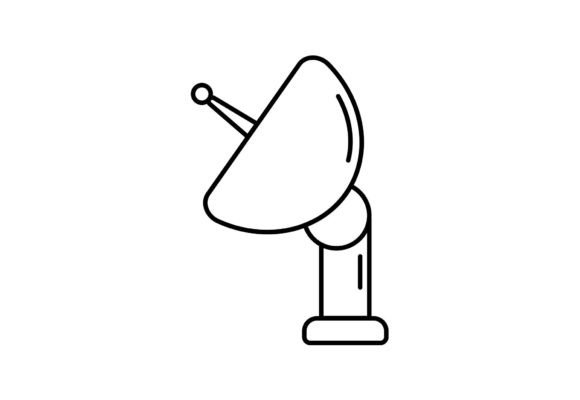
Antenna Outline Vector Graphic
A Clean, Quiet Signal — Not a Statement
The first thing that strikes me about the Antenna Outline Vector Graphic is its restraint. It’s not shouting — it’s tuning in. As an embroidery designer who’s stitched everything from dense floral monograms to cartoonish food icons, I appreciate how this design avoids visual clutter. It’s a single-line contour: clean, unbroken, slightly tapered at the tip, with subtle curvature suggesting both function and elegance. There’s no fill, no shadow, no gradient — just confident negative space doing most of the work. That makes it feel less like a tech logo and more like a quiet nod to curiosity, discovery, or even retro-futurism. Think lab coat pocket, science-themed baby onesie, or minimalist tote for a university bookstore — not a loud tech conference banner.
Where It Shines (and Where It Steps Back)
I recently tested the Antenna Outline Vector Graphic as a small chest emblem on a lightweight organic cotton sweatshirt for a local maker’s pop-up booth. At 2.2 inches tall, it stitched cleanly with a fine running stitch — no satin stitch needed, no fill stitch bulk. The outline held its shape beautifully across the fabric’s gentle drape, and customers responded warmly: “It feels smart but friendly,” one said. That’s the sweet spot. This design works exceptionally well for custom apparel where subtlety reads as sophistication — think embroidered caps for a podcast team, pillow covers for a STEM educator’s nursery, or tea towels for a science-themed kitchen boutique.
It also translates cleanly into an embroidered patch. When digitized with tight stitch spacing and a narrow satin border, the outline stays crisp without fraying or distortion during iron-on application. For small shop products like enamel pins or printed mockups, the vector clarity means sharp reproduction at any size — ideal for Etsy sellers bundling digital embroidery files with printable product previews.
Fabric & Fit: Know Its Limits
This isn’t a design built for compromise. On stretchy fabric like ribbed knits or performance tees, the thin line can distort if stabilizer isn’t precisely matched — I recommend cutaway + tear-away combo for anything with more than 5% spandex. On dark fabric, contrast becomes critical: a light thread (ecru, pale grey) reads elegantly, but white can look harsh unless balanced with matte thread. And on textured fabrics — think terry cloth towels or bouclé blankets — the outline may visually “sink” unless you increase stitch density slightly or add a tiny underlay.
It’s not ideal for baby embroidery on ultra-thin interlock or jersey without careful backing — the fine line risks puckering if tension shifts. Likewise, avoid placing it near curved seams or deep armholes on custom apparel unless you’ve tested hoop placement on a garment mockup first. And while it’s lovely on a flat apron front, skip the crown of a baseball cap — the curve compresses the antenna’s proportion and blurs the taper.
What It Adds to Your Finished Product
- Visual appeal: It elevates without overwhelming — perfect for buyers who prefer understated handmade charm over bold graphics.
- Stitching clarity: Minimal detail means fewer jump stitches, cleaner starts/stops, and faster hooping — a real time-saver for high-volume commercial embroidery.
- Product value: Customers perceive clean, intentional design as higher quality — especially when paired with natural fibers or eco-conscious branding.
- Brand consistency: As part of a craft business’s design assets, it slots neatly beside other minimalist icons (microscope, atom, circuit loop) without clashing.
- Giftability: Its neutral, thoughtful vibe makes it unexpectedly strong for personalized gifts — a graduation present for an engineering student, a holiday gift for a curious 8-year-old, or a wedding favor for a couple who met at a radio club.
Practical Embroidery Designer Notes
Before stitching your first machine embroidery design from the Antenna Outline Vector Graphic, do these five things:
- Test on scrap fabric — same type, same color, same stabilizer you’ll use on the final piece.
- Check thread color contrast in natural light and under store lighting — what looks subtle in daylight may vanish on a dark hoodie indoors.
- Review stitch density: Too sparse? The line breaks. Too dense? It stiffens and loses its airy feel. Aim for 0.6–0.8mm stitch length for running-stitch outlines.
- Confirm hoop size compatibility — this design scales well, but if you’re planning a 4-inch version on a cap, verify your machine’s max hoop clearance first.
- Inspect small details digitally: Zoom in on the tip and base — does the vector path close cleanly? Are anchor points smooth? Any stray nodes will cause digitizing hiccups.
Also: test it in black-and-white mockups before listing on Etsy. Does it hold presence against both light and dark backgrounds? Try pairing it with serif and sans-serif fonts in your branding — does it feel cohesive? And always verify licensing before selling finished items or bundling the digital embroidery file with other design assets. If it’s labeled for personal use only, you’ll need permission for commercial embroidery or resale as part of a handmade product.
Final Thought: A Design That Listens
The Antenna Outline Vector Graphic doesn’t demand attention — it earns it. In a market flooded with busy, saturated icons, its quiet confidence stands out. It’s not for every project, but for the right one — a science-themed baby blanket, a boutique’s limited-run sweatshirt, a teacher’s embroidered tote, or a craft fair’s best-selling patch — it delivers precision, personality, and polish. Just remember: minimal doesn’t mean effortless. Respect its simplicity with thoughtful digitizing, smart fabric choices, and honest testing. Then let it do what antennas do best — connect, clearly and quietly.